


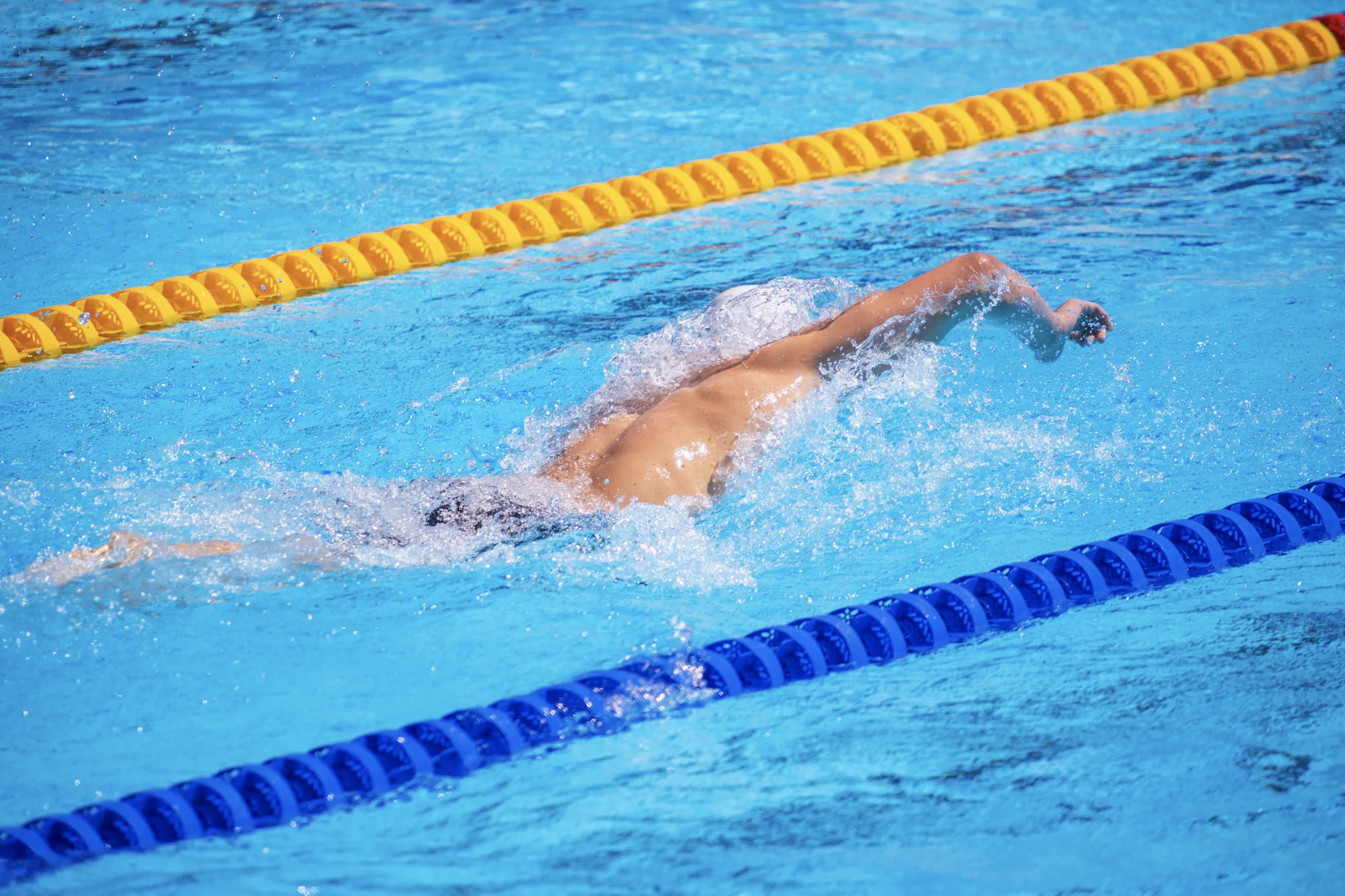
100 metres freestyle: The key phases of a fast race
A fast 100-metre race is not created by a single factor. Start, underwater phase, swimming speed and turn have to work as one system.
Knowledge platform
Expert knowledge for training, teaching and development in swimming. Free-access articles are available to everyone; Premium Knowledge is included with Bronze, Silver and Gold.
Articles
A fast 100-metre race is not created by a single factor. Start, underwater phase, swimming speed and turn have to work as one system.
A large race analysis shows which race phase has the greatest influence on final time at each distance.
A new study shows that greater propulsive force in freestyle only truly makes a swimmer faster when it matches the arm coordination.
Nine national-level breaststroke swimmers were analysed in three dimensions. At maximal speed, not only velocity but also the organisation of the kick changed.
A new biomechanical study compares joint movements and segmental coordination during the underwater dolphin kick across different performance levels.
A recent force analysis examines at what speed the transition from streamlined gliding to dolphin kick and then to freestyle becomes advantageous.
A new study on stroke length, stroke rate and glide time shows why a longer stroke is not automatically more efficient or faster.
New research shows that turns are not merely a technical detail—they even change the economy of a swimming performance.